Post
Aircraft safety
Air travel is getting safer

Safer skies
*Excluding ground casualties
The recent disappearance of flight MH370 has understandably gripped the world's attention, reigniting primal fears about the dangers of air travel. While such mysteries are terrifying, a look at the data reveals a reassuring truth: flying has become historically safe, even as our skies become more crowded.
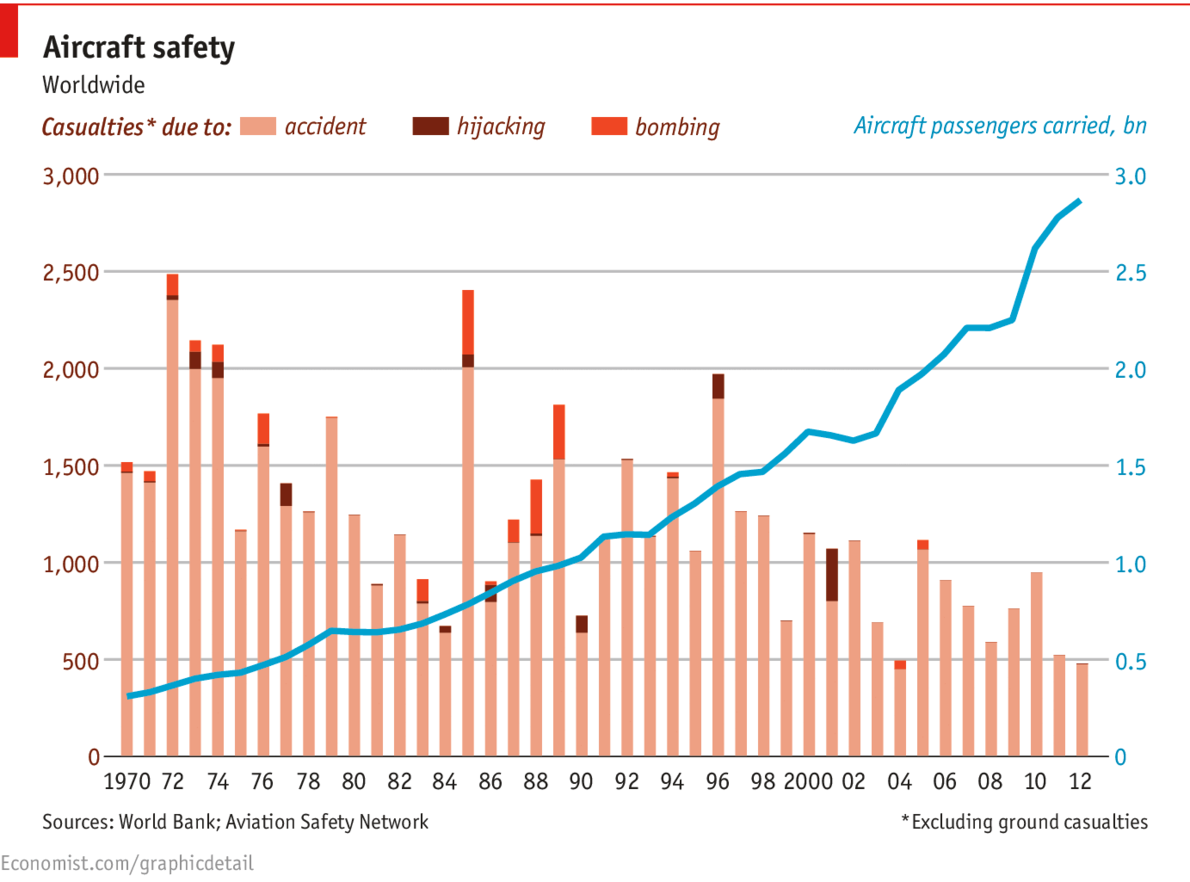
The chart above illustrates a remarkable divergence over the last four decades.
- Skyrocketing Traffic: The blue line tracks the number of passengers carried worldwide. In 1970, roughly 300 million people flew commercially. By 2012, that number had surged nearly ten-fold to approximately 3 billion passengers annually.
- Declining Casualties: Despite this massive increase in traffic, the number of fatalities (represented by the bars) has not risen. In fact, it has trended downward. While the early 1970s frequently saw years with over 2,000 casualties, recent years consistently show figures well below 1,000—and often below 500.
Analyzing the Risks
- Accidents (Pink): The vast majority of incidents remain accidental. Engineering and protocol advances have drastically reduced their frequency relative to the number of flights (despite recent high-profile incidents).
- Hostile Acts (Brown/Red): Hijackings and bombings, which caused visible spikes in fatalities during the 70s, 80s, and 90s, have become statistically negligible in recent years.
Putting Fear in Perspective
Aviation remains significantly safer than terrestrial alternatives. According to America’s National Safety Council, on a per-passenger-mile basis, an individual is about 180 times more likely to die in a car than on a plane.
While the mystery of MH370 is heightened because it occurred during the "cruise" phase—statistically the safest part of a flight, accounting for only 9% of fatalities—it remains an extreme outlier. The broader trend is undeniable: as the world connects more than ever before, the journey itself has never been safer.
Original Graphic